
Local SEO costs depend on what needs to be fixed, how many locations you operate and who will carry out the work. A listing-management subscription, a one-time cleanup and an ongoing local search program are different purchases, even when all three are advertised as local SEO.
For a concrete reference, public starting prices checked on November 3, 2026 included BrightLocal's managed local SEO service from $499 per month and WebFX's local SEO plans from $575 per month. These are individual providers' entry prices with their own scope and terms. They are not a universal price range or a quote for my services.
Common pricing structures include a software subscription you operate yourself, a one-time project fee for an audit or cleanup, a monthly retainer for ongoing management, or a combination. Identify the structure before comparing the price. Use published prices to understand the types of offers available. Use a written scope to decide what your business actually needs.
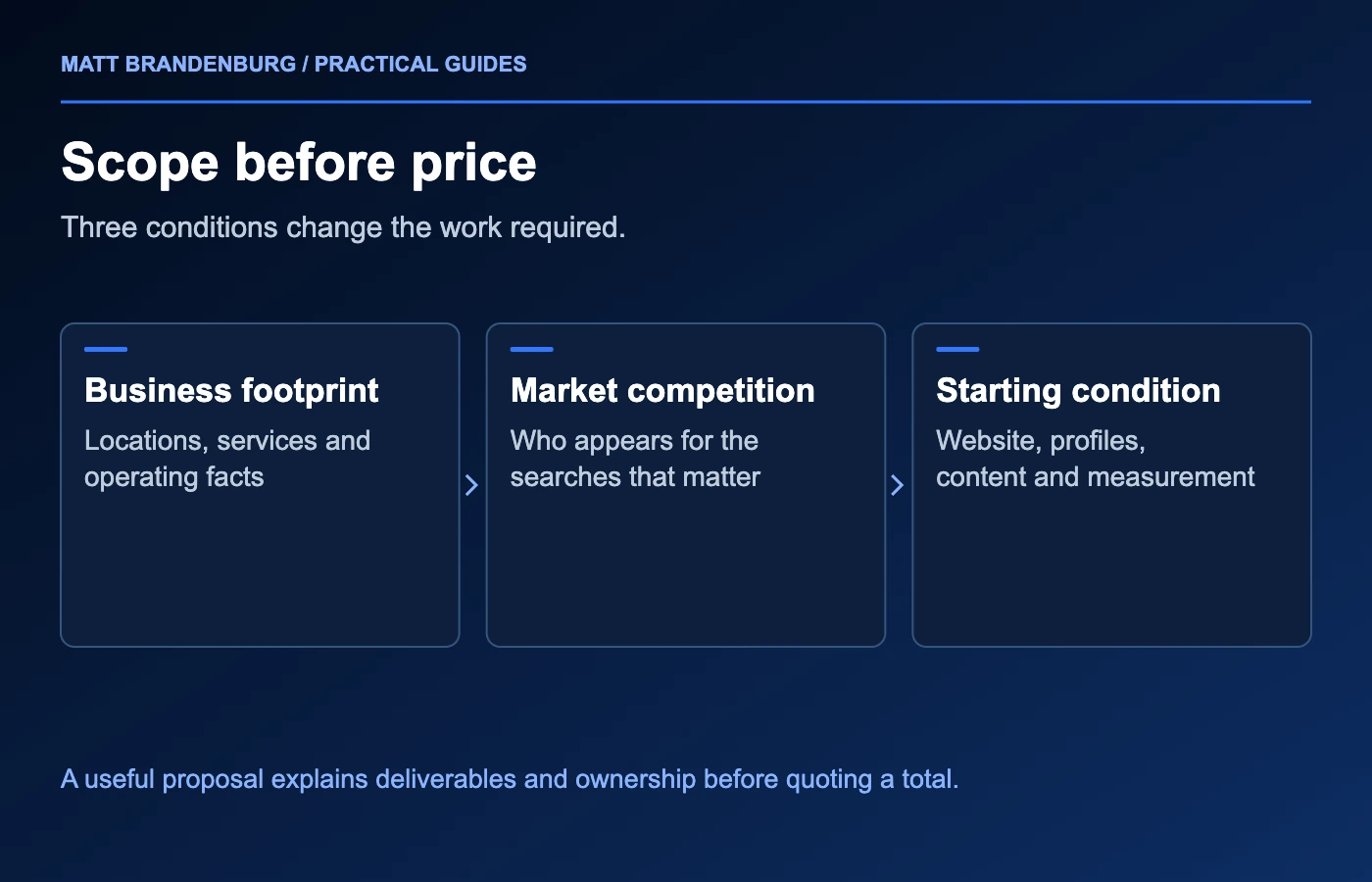
1. Define the problem before choosing a package
Start with the customer and the service you want them to find. List your actual locations, the areas you serve and the work you want more of. Then identify the immediate problem.
Is the Business Profile inaccurate or inaccessible? Are important service pages missing? Does the business appear well near one location but poorly elsewhere? Are inquiries increasing without anyone recording where they came from?
Each problem creates a different work plan. A proposal for monthly publishing will not necessarily resolve an ownership issue. A directory cleanup will not repair a broken contact form. A large ranking report is not useful if no one has agreed which services or places matter.
Before asking for quotes, prepare a short brief with:
- The main services and customer types you want to attract.
- The real locations and realistic service area.
- Existing website, Business Profile and analytics access.
- Known issues, recent moves or website changes.
- Who can approve content, provide photos and make website changes.
My Local SEO Market Planner can help organize the markets to investigate. The purpose is to narrow the work to a useful scope, not to assume every nearby city needs its own campaign.
2. Separate the initial work from ongoing management
An initial project should establish what exists, what is wrong and what will be changed. Ask whether the quoted audit includes implementation. A detailed findings document and a completed set of repairs are different deliverables.
Depending on the site, the initial work might include correcting profile details, resolving conflicting business information, improving service-page clarity, repairing technical problems or establishing reliable measurement. Some problems require specialist support or evidence from the business owner.
Ongoing work should respond to actual needs: changing hours, new services, website improvements, customer questions, reviews, competitive changes and performance findings. Ask the provider to explain how those needs determine the work, rather than promising the same fixed set of posts every month.
| Part of the proposal | Question to ask |
|---|---|
| Audit | Will I receive findings, priorities and an explanation of the evidence? |
| Implementation | Who changes the website and profile, and is that work included? |
| Content | Which existing pages need improvement, and why is any new page needed? |
| Local listings | Which records will be checked or corrected, and who retains access? |
| Reviews | Who monitors and responds, and how are reviews requested within Google's review policies? |
| Reporting | Which searches, locations and received inquiries will be measured? |
My Local Search and Maps services bring these pieces together where local discovery affects the business. Broader technical and content work may also belong in the SEO plan, so clarify how the two scopes fit rather than paying twice for the same task.
3. Account for the number and type of locations
A single storefront, a business that travels to customers and a company with several staffed locations need different arrangements.
For one storefront, the work can concentrate on a specific profile, local customer questions and relevant website pages. A service-area business needs an accurate representation of how it operates and a realistic view of where it can compete. Several locations require a way to keep each location's details, pages, approvals and reporting accurate.
Use this as a planning matrix, not a pricing formula:
| Business setup | Scope to examine |
|---|---|
| One storefront | Profile accuracy, service information, local visibility and contact paths. |
| Service-area business | Eligible profile setup, actual coverage, service-page usefulness and location-dependent visibility. |
| Several locations | Location-specific information, shared standards, individual reporting and coordination with each team. |
Adding locations can create more work, but multiplying one package by the number of branches may not describe it accurately. Some research and templates are shared; other tasks require local verification. Ask which parts are shared and which are handled separately.
Likewise, a long list of cities in a proposal is not evidence of a local presence in each one. Avoid paying for near-identical pages with little useful information for customers.
4. Know what software does—and who does the rest
Software can help collect ranking data, monitor listings or organize updates. It still needs correct inputs and someone who can act on the findings.
The distinction is visible even within one provider: BrightLocal's pricing page separates do-it-yourself platform access from managed services. A tool price should therefore not be compared directly with a fee that includes human research, website implementation and ongoing decisions.
Ask who will handle exceptions. If a listing cannot be corrected automatically, who follows up? If the website needs a development change, who makes it? If a report shows a drop, who checks whether the measurement is comparable and identifies a useful response?
Also ask what happens when a subscription or service ends. Clarify access to profiles, website content, reports and vendor accounts. Make sure the proposed arrangement leaves you able to operate your own business information.
5. Compare total cost and evidence of useful progress
Put each proposal into the same format: one-time fees, recurring fees, included tools, additional website work, minimum term and work that remains with your team. A lower headline fee may simply cover fewer tasks; a higher fee needs a clear explanation of the added work.
Agree on a baseline before changes begin. My geo-grid guide explains how to read location-dependent visibility, while the measurement framework separates that visibility from inquiries and qualified opportunities. Useful reporting can distinguish completed repairs, relevant visibility, website visits, received inquiries and qualified opportunities. A better position for a search you do not serve is a different result from more appropriate customers contacting you.
Ask how progress will be assessed and what would cause the plan to change. Avoid treating a promised ranking or fixed result date as a substitute for that explanation. Google's advice on hiring an SEO notes that no one can guarantee a #1 ranking on Google.
If you want a proposal that reflects your business, start with your locations, services and current constraints. See what working together involves, then choose a scope you can understand, support and evaluate.