
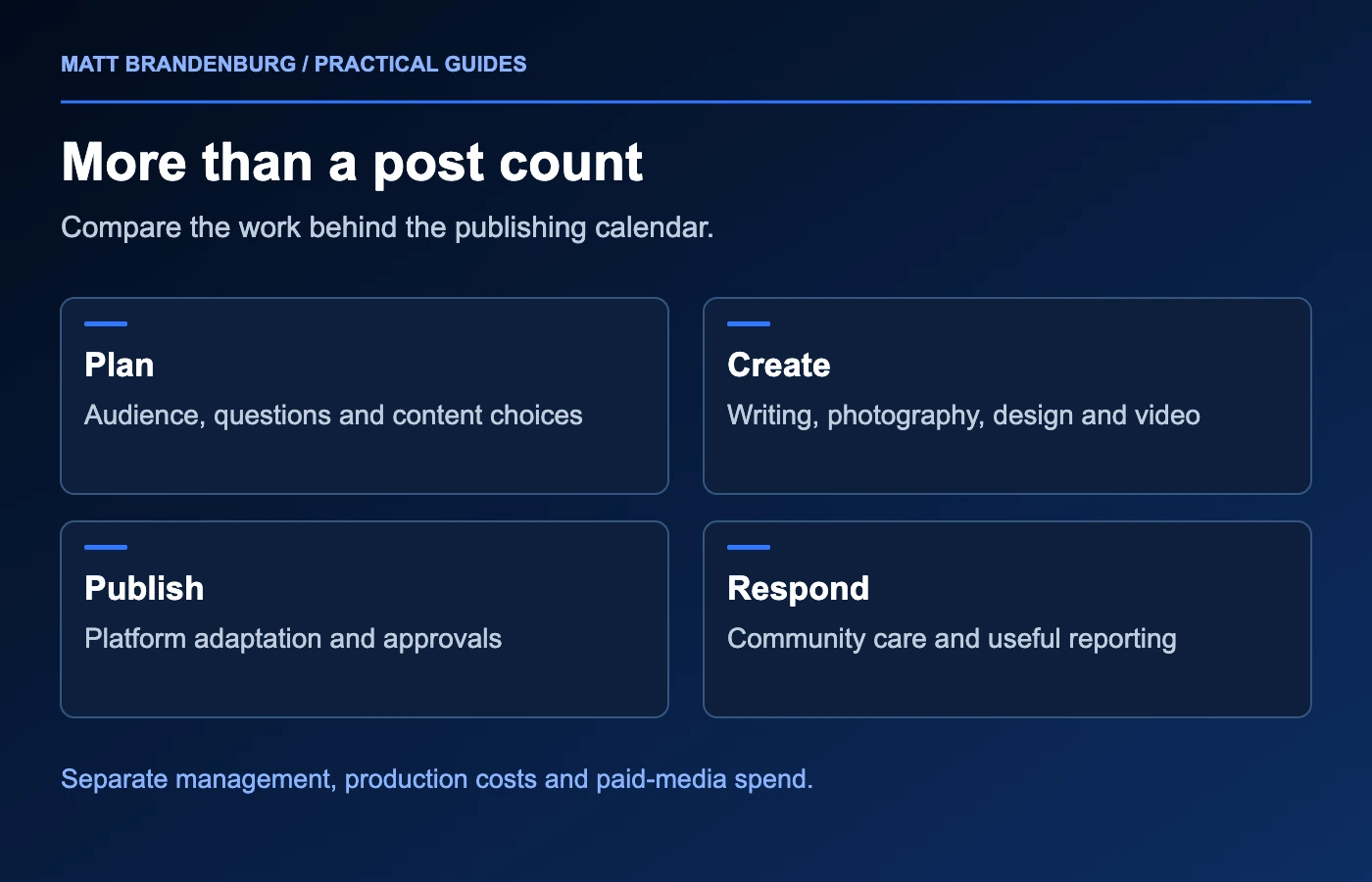
Social media management cost depends on the work behind the posts: planning, photography, video, writing, approvals, publishing, customer responses and reporting. For a service business, the best comparison starts with those responsibilities rather than a price per post.
Published offers show why scope matters. When checked on November 3, 2026, LYFE Marketing's Starter plan listed $750 per month for 12 image posts across Facebook and Instagram, alongside monitoring and responding. WebFX's Bronze plan listed $3,150 per month, a $4,650 setup fee and $100 in required boosted-post spend, with a different set of deliverables.
These are specific providers' published offers, not a market average, a quality ranking or my team's pricing. They demonstrate why the number alone cannot tell you which proposal fits your business.
1. Decide what the business needs social media to do
Start with a useful outcome. A local service company might need prospective customers to understand its work, see credible examples and know how to make an inquiry. Another business may need ongoing communication with existing customers or a place to answer common questions.
Write a short brief covering the audience, services, geographic coverage and available proof. Identify the next step you want an interested person to take: view a service page, ask a question, book a consultation or call.
That brief gives the content a purpose. A schedule full of unrelated holidays and generic quotes can be easy to produce while doing little to explain why someone should choose your business.
Also decide how social media fits with other channels. A useful project explanation may support a website page, a sales conversation and a social post. Coordinating these pieces through a broader marketing services plan can prevent separate teams from repeatedly requesting the same material.
2. Compare original content with repurposed posts
Twelve posts can represent very different amounts of work. Twelve versions of existing graphics differ from a month that includes a location visit, interviews, new photography and edited video.
Ask what “content creation” means in the proposal:
| Deliverable | Detail to confirm |
|---|---|
| Photography | Who takes the photos, how often and at which locations? |
| Video | Who records footage, edits it, adds captions and creates different formats? |
| Writing | Who supplies the facts, checks claims and adapts the message? |
| Design | Are graphics original, template-based or adapted from existing materials? |
| Revisions | How many review rounds are included, and what counts as a new request? |
| Asset rights | Can the business reuse the files, and are any licenses restricted? |
For example, a hypothetical contractor could supply approved project photos and technical notes for the manager to turn into posts. Alternatively, the manager could arrange a shoot and interview the team. Both arrangements can be useful, but they need different budgets and commitments from the business.
Repurposing is not automatically a compromise. A strong customer question can become a short video, a helpful written post and a useful website explanation. The important distinction is whether the material answers something real and is appropriate for the platform.
3. Define platforms, approvals and response ownership
More platforms create more places to maintain information, adapt content and check responses. Choose them because the audience and content fit, not because a package includes a long list of logos.
Confirm whether the quoted post count means unique pieces of content or total placements. If one item is published to Facebook and Instagram, does the provider count it once or twice? Neither definition is inherently wrong, but both parties should use the same one.
Set up an approval process with a named reviewer and a reasonable deadline. Decide how time-sensitive updates will be handled and what happens when approval is late. The manager needs enough accurate information to publish; the business needs visibility into what is being said in its name.
Community management needs equally clear boundaries. Ask which comments and messages will be monitored, during what hours and how quickly the team aims to respond. Identify the questions that require someone at the business: availability, detailed quotes, complaints or changes to an appointment.
A useful handoff includes the inquiry, the responsible person and confirmation that someone followed up. A reply saying “please call us” may be appropriate in some circumstances, but it does not establish that the customer reached the business.
4. Separate management, software and advertising
Put three categories on the budget: people doing the work, software supporting the work and media spend paid to platforms. Confirm which subscriptions are included and which will be billed separately.
For example, Buffer's pricing page offers a free software tier and paid channel-based plans. That is access to software, not a person who will interview your team, photograph a project, resolve a complaint or decide what your business should say.
Advertising requires its own scope. Clarify whether the service includes only boosting selected posts or also managing broader paid campaigns. Ask who writes the ads, creates the destination pages, checks lead tracking and reviews lead quality.
Avoid assuming that an “advertising included” line means media spend is included in the fee. Get the platform budget and the management charge in writing. Also ask whether changes to an ad or post after approval are included or billed as a new request.
This separation helps you make a practical choice. You may already have someone who can supply photos but need help with planning and reporting. Or you may have an experienced internal marketer whose main constraint is producing original video. The proposal should address that constraint directly.
5. Use one worksheet to compare proposals
Give every provider the same requirements and fill in the missing answers before deciding. Include platforms, unique content pieces, formats, production days, review rounds, response coverage, advertising scope, software and reporting.
Add the financial terms: one-time setup, monthly fee, extra production charges, media budget, minimum commitment and cancellation process. Note any work that remains with your team. An offer that needs several hours of your staff's time each week has a different operating cost from one that handles that work for you.
Then agree on useful reporting. Reach and engagement can show how content is being seen and used. Website visits, received inquiries and qualified opportunities answer different business questions. My marketing measurement framework explains why those stages should remain distinct.
The goal is a manageable plan with a clear purpose, reliable content inputs and someone responsible for each next step. Explore the social media marketing service led by Lindsey, or tell us what your business needs to communicate so we can discuss a suitable scope.