
Choose between SEO and PPC by looking at the business problem, the evidence available and how soon you need to learn. SEO can improve your website's ability to earn relevant organic visibility. Paid search can put an offer into advertising auctions with a defined budget. Neither approach guarantees qualified leads or sales.
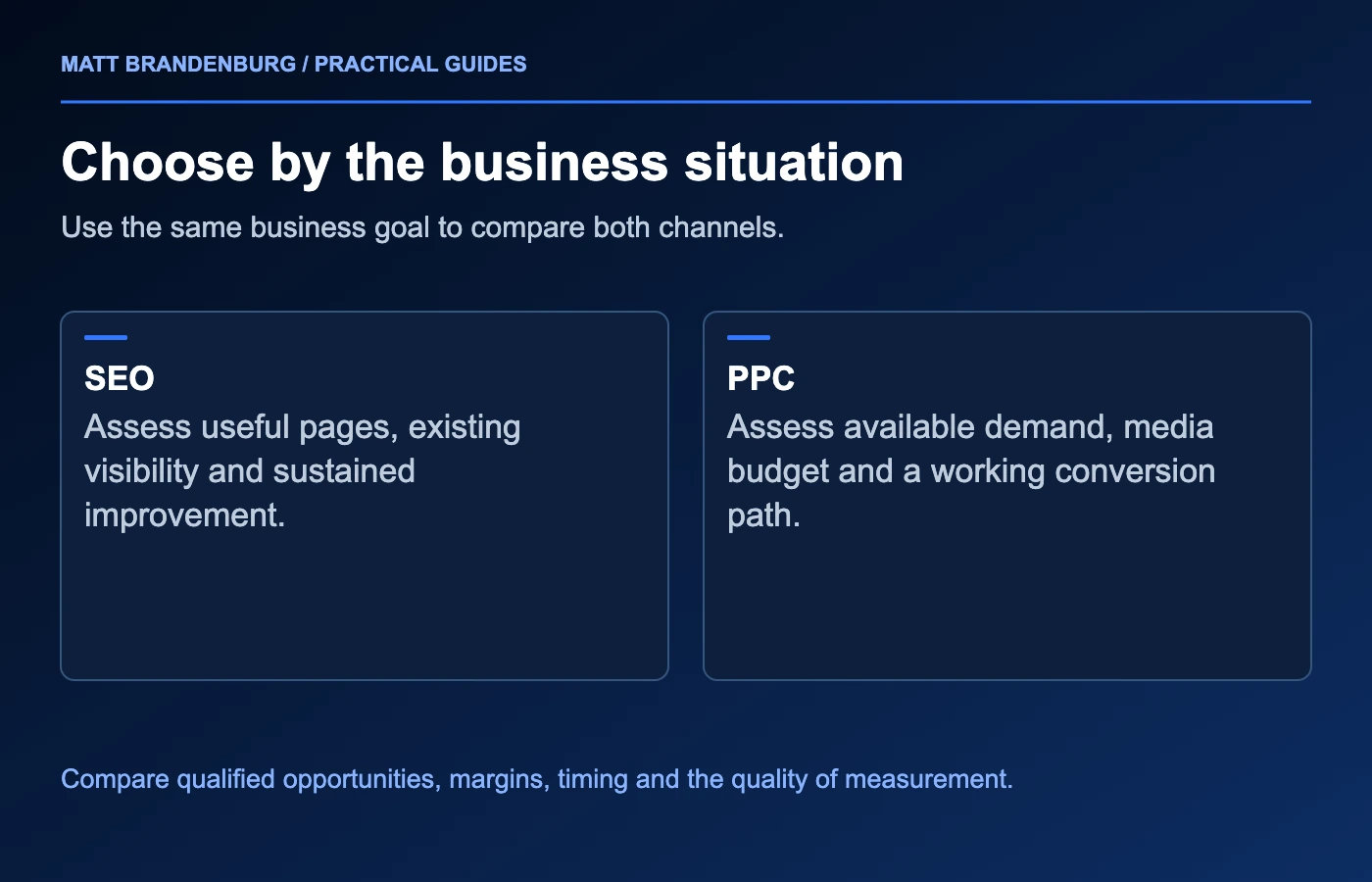
For a business with a clear offer, reliable tracking and capacity to handle inquiries, a focused paid-search test may be useful while organic work develops. For a business with valuable existing search visibility and neglected service pages, improving those pages may deserve the first investment. If the website or inquiry process is broken, fix that before trying to send more people through it.
1. Understand what you are buying
SEO involves work on the website and the information surrounding the business: technical access, page usefulness, service clarity, internal navigation and credible evidence. It takes time and resources even though an organic click does not carry a search-engine advertising charge.
PPC involves paying for advertising interactions under the platform's rules, alongside any management and production costs. For search campaigns, your ads participate in auctions. Your bid matters, but placement is not simply awarded to whoever bids the most. Google also considers ad and landing-page quality, Ad Rank thresholds, auction competitiveness, search context and the expected impact of ad assets. Google's Ad Rank documentation explains this distinction.
Buying ads also does not buy a better organic position. Google's guidance on hiring an SEO states that it does not accept payment to include or rank sites in its organic search results.
| Decision factor | SEO | Paid search |
|---|---|---|
| Main investment | Improving and maintaining useful, accessible pages and supporting evidence. | Media spend, campaign management, creative, landing pages and measurement. |
| Control | You control your site; search engines decide crawling, indexing and ranking. | You can set campaign inputs and budgets; auctions and policies affect delivery. |
| Learning | Search performance and customer feedback can reveal opportunities over time. | A focused campaign can test an offer and audience if it receives enough useful activity. |
| Ongoing work | Maintain relevance, accuracy, technical health and useful content. | Monitor spend, queries, ads, destination pages and the quality of inquiries. |
Timing also differs. Ads can begin competing once the campaign is active, the account and ads are eligible, and other delivery requirements are met; Google reviews ads before they can run. Organic changes need time to be processed, and Google notes that their effect can vary widely. Neither a campaign launch nor a website update promises a result by a fixed date.
The right choice comes from how those characteristics fit your current situation, not a claim that one channel always wins.
2. Check the foundations both channels need
Before allocating money, walk through the customer journey on a phone. Can someone understand what you offer, whether you serve their area and how to contact you? Coordinate a test inquiry with your team, clearly label it as a test and confirm it reaches the right person. Check that calls reach a team prepared to handle them.
Next, define a qualified opportunity. For a contractor, that might require the right service, location and project type. For a B2B supplier, it might involve a technical requirement and a credible purchasing process. The definition should match the business rather than whatever event is easiest to count.
Review capacity and economics as well. More inquiries are not automatically helpful if the team cannot respond or if the requested work is unsuitable. Estimate what a typical customer contributes after the direct cost of delivering the work, and use that context when evaluating customer acquisition costs. To assess the amount you can afford per qualified opportunity, also account for the share of those opportunities that become customers.
Finally, establish the starting point. Look at relevant organic visits and inquiries, current advertising performance, available service pages and known tracking gaps. My marketing measurement framework separates visibility, activity, received leads and business outcomes so these checks do not get collapsed into one number.
3. Choose a first move for your situation
These four scenarios are hypothetical planning examples, not client case studies or predictions.
A new service with an urgent need to test demand. The business has a clear offer, a credible landing page and someone ready to respond. A limited paid-search test may help reveal which relevant searches produce useful inquiries. Define the spend limit and learning question first. In parallel, make the core service information available on the website so the business is building an organic foundation.
An established business already receiving relevant organic inquiries. Important pages have outdated information, and customers repeatedly ask questions the site does not answer. Improving those pages and fixing identifiable technical issues may be a sensible first priority. The existing query and inquiry evidence gives the work direction. Paid search can still test an uncovered service or market if there is a specific reason to do so.
A local business with inaccurate information and missed calls. The website, Google Business Profile and reception process need attention. Start with accurate information, usable contact paths and reliable follow-up. Campaign expansion can wait until the business is capable of receiving and evaluating the demand it already attracts. If local visibility is the main concern, see how I approach Local Search and Maps.
A specialist B2B company with a longer buying process. Buyers need specifications, application details and evidence before contacting sales. Build the pages that support those decisions. A narrow paid-search campaign may complement that work, but judge it against appropriate opportunities and sales-cycle timing rather than expecting every visit to produce an immediate sale.
In each example, the first move addresses a visible constraint. That makes it easier to explain what the investment is intended to change and how to judge the result.
4. Use both channels when each has a clear job
SEO and paid search can support the same business goal while answering different questions. A useful service page can help organic visitors and serve as an advertising destination. Search-term observations from an advertising campaign can suggest customer questions worth investigating in content. Organic query data can reveal a service or concern that merits a focused test.
Treat those observations as leads for research. A term that receives paid clicks is not automatically a suitable new article, and an organic page's traffic does not prove an ad campaign would be profitable.
Keep the core message consistent: the service, eligible customer, coverage, proof and next step should match what the business can deliver. Then give each channel its own measurement. Do not add platform totals together without checking for overlapping attribution or repeat inquiries.
My SEO work and PPC and paid media work can be coordinated around these shared business requirements, with a specific role for each channel.
5. Review qualified outcomes and adjust the allocation
Choose a review period suited to the activity and buying process. For advertising, include media, management and relevant production costs. For organic work, include the costs of the work being evaluated. Keep one-time setup costs visible so they do not quietly disappear from the comparison.
A simple measure is cost per qualified opportunity: the relevant marketing cost divided by the number of opportunities meeting your definition. Pair it with lead quality, follow-up and eventual customer outcomes. If the sales cycle is long, avoid judging a recent group of inquiries as though all of them have already had time to close.
Before changing the budget, ask what the evidence supports. Are the searches relevant? Did the contact path work? Were inquiries handled? Has enough useful activity occurred to assess the test? Did a reporting change alter the totals?
Start with the channel or repair that addresses the clearest need, give it a defined purpose and review what happens. If you want help choosing that first move, tell me about your current traffic, inquiries and business goals.