
You can ask Google to remove a review that violates its policies. A low rating, harsh opinion or account of a disappointing experience is not automatically removable. The first step is to distinguish a policy issue from a customer-service issue, then choose a response that fits the evidence.
That distinction protects your time and your reputation. A clear report gives Google a specific issue to evaluate. A calm response to legitimate criticism gives future customers useful information about how your business handles problems.
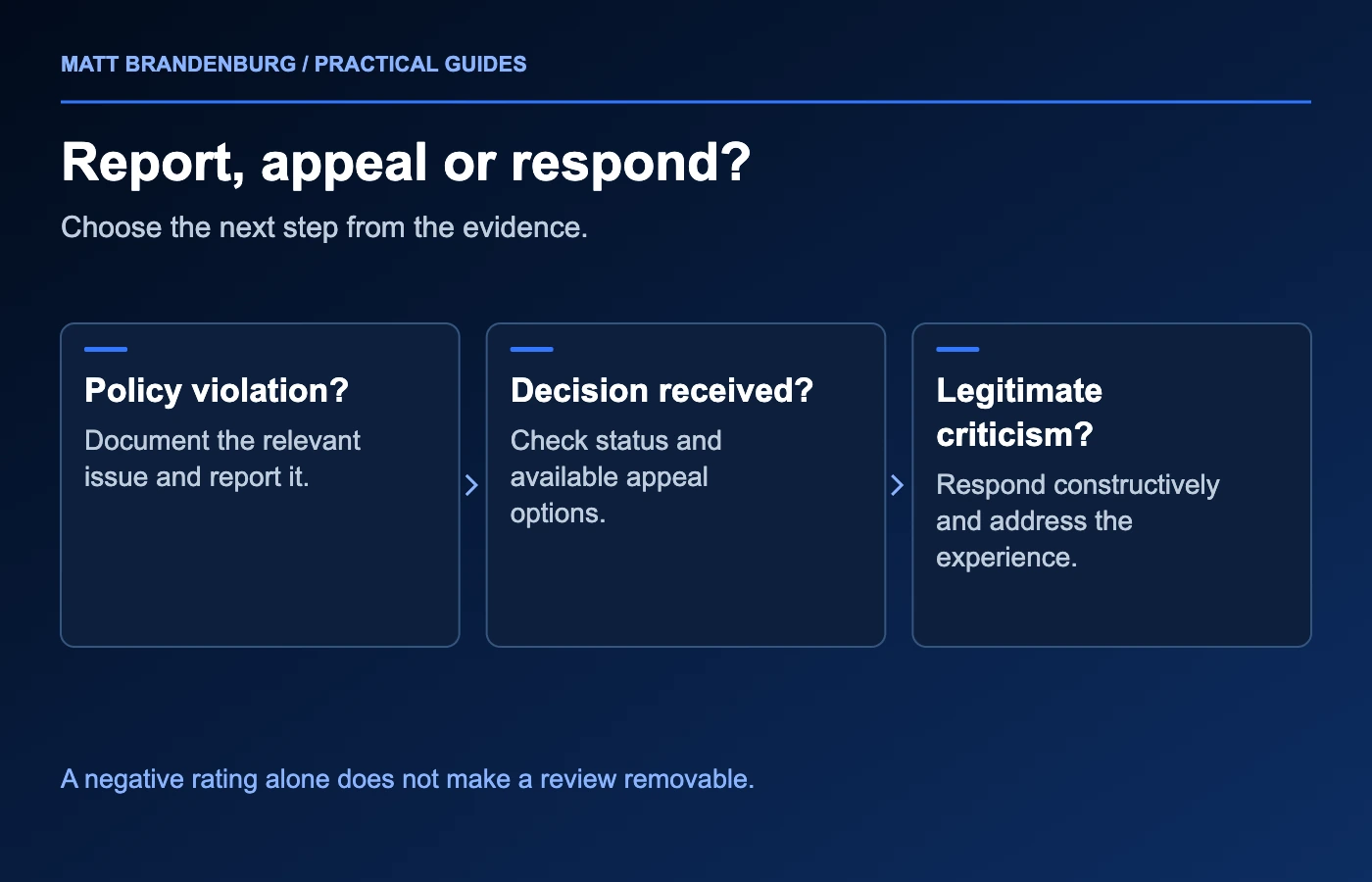
1. Read the review before deciding what to do
Save the review's link, text, rating and date in a private record. Note which location it concerns and whether the reviewer describes a particular service, visit or transaction. Then ask the appropriate person at the business to check the facts.
Do not assume a review is fake because you cannot immediately match the display name to a customer. People may use a different name online, contact the business without making a purchase or describe an interaction your team has not yet found.
Separate what you know from what you suspect. “We have no customer under this display name” is an observation. “This is definitely a competitor” is a conclusion that needs evidence.
Use a short decision record:
| Question | What to record |
|---|---|
| What does the review claim? | A concise, neutral summary. |
| What can the business verify? | Relevant dates, service details and internal findings. |
| Is there a specific policy issue? | The applicable policy and supporting evidence. |
| Does the customer need a response? | The responsible person and a suitable contact route. |
| What is the next action? | Report, investigate, respond or follow up privately. |
Keep customer records private. You do not need to publish invoices, messages or personal information to show that you take a complaint seriously.
2. Compare the content with Google's policies
Google's Maps content policies cover issues such as fake engagement, conflicts of interest, impersonation, harassment and certain personal information. A report should identify the relevant issue rather than treating “negative” as a policy category.
For example, a review offering unrelated promotional content raises a different question from a customer saying an appointment started late. A specific threat raises a different concern from a strongly worded opinion about price. Read the applicable policy carefully; the category you choose should match what the review actually contains.
You should also avoid trying to change the rating through incentives. Google prohibits offering payment, discounts or free products or services in exchange for posting, revising or removing a review. It also prohibits selectively soliciting positive reviews. A normal customer-service resolution should not depend on the customer changing their public feedback.
If the evidence does not establish a policy violation, you can still investigate the experience and decide how to respond. That work may be more useful than repeatedly submitting the same unsupported report.
3. Submit a focused report through the official route
Google provides a reporting option beside reviews and a Reviews Management Tool for reporting and checking progress. Select the business and review, choose the reason that fits, and submit. Use Google's current reporting instructions, since interface labels can change.
Before you submit, make your private evidence note understandable to someone who knows nothing about the situation. A useful format is:
- The review link and affected business location.
- The precise policy issue you believe applies.
- The specific text or behavior that supports that concern.
- Supporting details for your private record and any evidence field Google provides during an eligible appeal.
The standard report may only ask you to select a reason. Keep your private note, and any explanation you can submit through an eligible appeal, factual. A long account of how upset the business feels is unlikely to clarify whether a particular rule was broken. Avoid accusations you cannot support, and do not add unrelated complaints about other reviewers.
Assign one person to maintain the record. That makes it easier to see what has already been submitted and prevents colleagues or contractors from working from conflicting versions of the situation.
4. Check the decision and use an eligible appeal
The Reviews Management Tool can show whether a report is pending or has been evaluated. If Google finds no policy violation, its current process allows one appeal for an eligible review using the option shown in the Reviews Management Tool. Follow the options shown for the actual case. A pending report is not a removal decision, and an appeal does not guarantee a different outcome. Google explains these statuses and appeal steps.
If you appeal, strengthen the explanation where evidence was missing or unclear. Identify what matters to the policy question rather than simply repeating that the review is damaging.
There is also a separate route for review extortion. If someone demands money or another benefit in exchange for removing negative reviews, preserve the messages and review links. Google advises businesses not to pay or engage with the demand and provides an extortion reporting process. Keep that evidence out of a public argument with the reviewer.
Be skeptical of anyone promising guaranteed removal regardless of the content. Ask what policy applies, what evidence supports the case and what service is actually being offered.
5. Respond constructively when a legitimate review remains
Read the review from the perspective of the next potential customer. They want to know whether the concern was understood and whether the business has a reasonable way to address it.
Google's review-response guidance recommends professional, concise replies and cautions against sharing private information. You can acknowledge a concern without publishing every detail or conceding something you have not verified.
A hypothetical response to a communication complaint might be:
Thank you for sharing this. We are sorry the communication left you frustrated. Please contact our office using the details on our website so we can look into what happened with you directly.
Adapt that wording to the facts and the action your team can genuinely take. Do not promise an investigation if no one has been assigned to follow up. If the business made an error, address it directly. If details are uncertain, invite a private conversation without publicly speculating about the customer's identity or motives.
Keep a separate note of the operational lesson. Repeated confusion about estimates, arrival windows or follow-up may point to an issue worth correcting even when removal is not appropriate.
6. Build a dependable review process
Create a routine for noticing new reviews, assigning responses and following up on unresolved concerns. Ask customers for honest feedback consistently, without making the request depend on whether you expect a positive rating.
The aim is an accurate, useful public picture of the business. That fits the broader work of Local Search and Maps: making business information clear, helping customers evaluate the service and tracking what changes.
My results and measurement standards explain how I distinguish evidence from promises. If you need help evaluating a review issue or improving the surrounding process, start a conversation with the review link and a factual description of the concern. Leave customer records and other private details out of your initial message.