
PPC management pricing is the fee for planning, running and improving your advertising. It is usually separate from the money paid to the advertising platform. Before comparing two quotes, separate those costs and establish what work each fee covers.
A lower management fee can be a sensible choice for a simple account. It can also leave landing pages, tracking repairs or creative production outside the agreement. The useful comparison is the total cost of the work you need, with clear responsibilities and a way to judge the results.
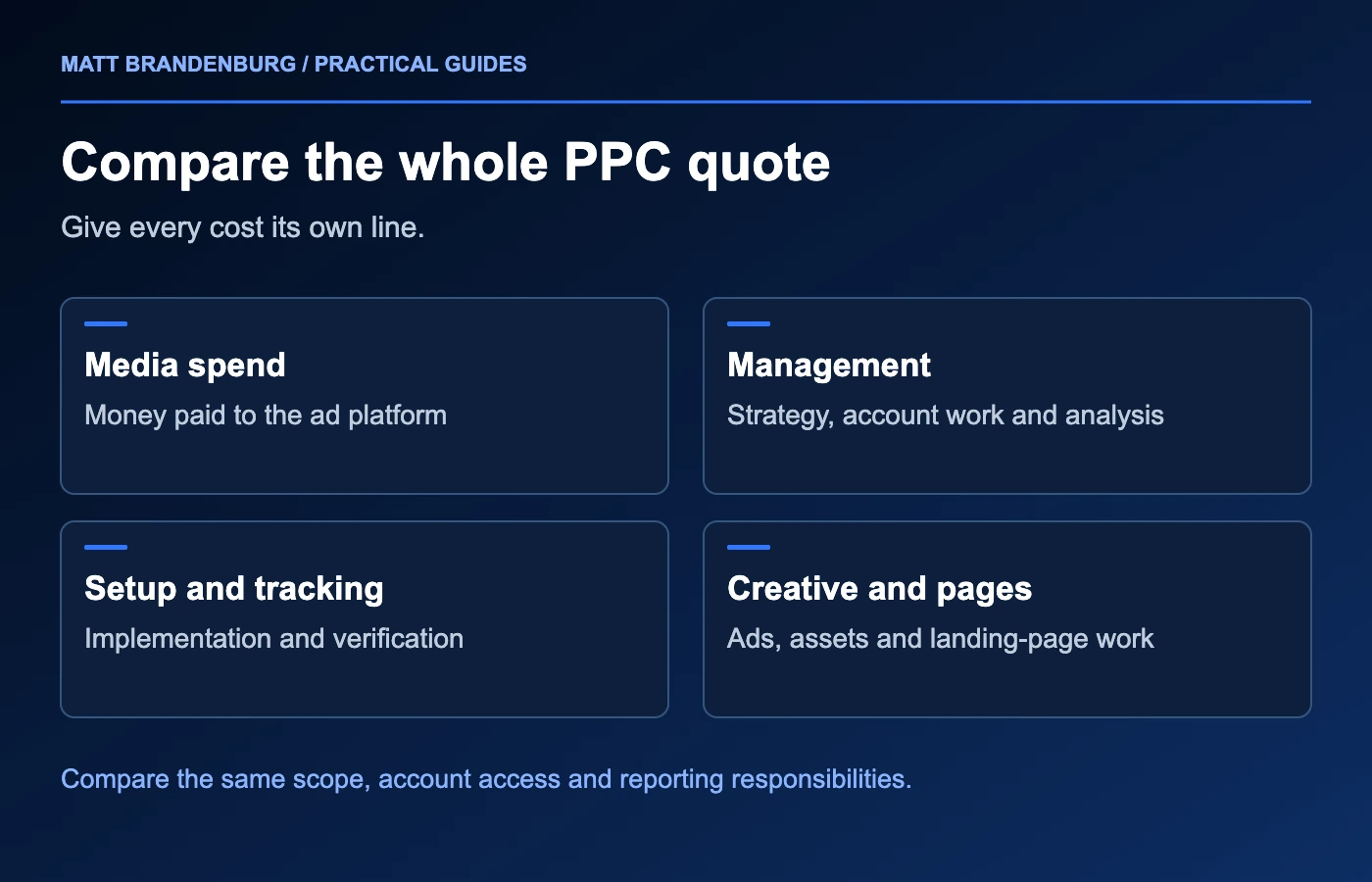
1. Separate the management fee from the advertising budget
Ask for a proposal that shows each of these lines, even if some are marked “included” or “not required”:
| Cost | What to clarify |
|---|---|
| Advertising spend | The amount paid to Google or another advertising platform. |
| Ongoing management | Strategy, account changes, monitoring, testing and communication. |
| Initial setup or rebuild | Research, account structure, initial ads and migration of existing work. |
| Landing pages | Writing, design, development, hosting and future revisions. |
| Creative production | Photography, video, graphics and asset revisions. |
| Measurement | Form tracking, call tracking, analytics, CRM connections and related subscriptions. |
| Media billing | Whether the platform bills you directly or the provider re-invoices you, and whether a markup is added. |
Some businesses need only a portion of this work. An established campaign with reliable measurement has a different starting point from a new account with no service-specific landing page.
Under Google's third-party policy, providers managing Google Ads for clients must disclose management fees to new customers in writing before the first purchase and on invoices. Google advertising costs should be distinguishable from the provider's fees. This is a Google policy; ask providers using other platforms to explain their billing arrangements as well. You should be able to understand where the money goes without reverse-engineering a combined invoice.
2. Understand how the fee is calculated
Four pricing structures are worth recognizing. The structure explains the bill; it does not establish the quality of the work.
Flat monthly fee. You pay an agreed amount for a defined scope. Ask which platforms, campaigns and markets it covers, and what would trigger a change in price.
Percentage of advertising spend. The management fee changes with media spend. Ask whether a minimum fee applies, whether the percentage changes at spending thresholds, and whether increases in spend require your approval.
Hourly or project pricing. This can suit a defined audit, tracking repair or account rebuild. Agree on the deliverable, estimate and approval process for additional work. Establish who will manage the campaigns after the project ends.
Hybrid or performance-related pricing. A base fee may be combined with a percentage or outcome-based charge. Define the billable outcome carefully. A form submission, qualified inquiry and completed sale are different events. Decide how duplicates, spam, existing customers and cancellations will be handled.
For a public provider example, Sagapixel's pricing article described its own fee as 15%–22% of ad spend, with a $4,000 cap, when checked on November 3, 2026. That is one agency's published model, not a market average or a quote from me. Always check the provider's current proposal and the work included.
3. Compare the work behind the number
Send each provider the same short brief: the services you want to promote, target market, current account, available landing pages, monthly media budget and how inquiries are handled. That makes the resulting quotes more comparable.
Then ask for specifics in five areas:
- Account attention: Who checks search terms, targeting, budgets and unexpected changes? How are issues communicated?
- Testing: Which ads, offers or landing-page elements can be tested within the fee? Who creates the materials?
- Measurement: Who verifies that a submitted form reaches the business and that a phone call is attributed appropriately?
- Lead feedback: How will the provider learn which inquiries were suitable, which became customers and which were irrelevant?
- Access and handover: What access will you retain to the advertising account, analytics, landing pages and reporting? What happens when the engagement ends?
Ask for examples of deliverables rather than a promise that the account will be “fully optimized.” A sample change report, measurement checklist or testing plan can reveal more than a long list of platforms.
Your business has responsibilities too. Someone must approve offers, provide accurate service information and respond to leads. If those tasks are missing, a higher management fee will not resolve the whole problem. My PPC and paid media services connect campaign work with the measurement and business decisions needed to evaluate it.
4. Calculate the complete cost with the same assumptions
The following numbers are illustrative only. They are invented for comparison, not typical market prices, expected results or my fees.
Suppose two proposals use a $3,000 monthly media budget:
| Illustrative cost | Proposal A | Proposal B |
|---|---|---|
| Monthly advertising spend | $3,000 | $3,000 |
| Monthly management | $600 | $900 |
| One-time setup and measurement work | $1,200 | Included |
| Three-month total | $12,000 | $11,700 |
Proposal A: 3 × ($3,000 + $600) + $1,200 = $12,000. Proposal B: 3 × ($3,000 + $900) = $11,700. The cheaper monthly fee produces the higher three-month total in this example.
That arithmetic does not make Proposal B the better service. The comparison is useful only if the scope is equivalent. If one includes landing-page changes and the other does not, add the expected cost of the missing work or record it as a difference you are willing to accept. Include taxes and third-party charges where applicable.
Use the same approach for a longer commitment. Record recurring costs, one-time costs, minimum terms, cancellation conditions and any expenses that continue after the engagement ends. Avoid judging an agreement from a promotional first-month price alone.
5. Decide what would make the fee worthwhile
Agree on success measures before work starts. Clicks and platform-reported conversions can help explain activity, but the business also needs to know whether inquiries were received, relevant and commercially useful.
For a service company, a practical review might connect advertising cost to received inquiries, qualified opportunities and booked work. Allow for the time it takes a genuine opportunity to become a customer. Keep the definitions consistent so a reporting change does not look like a sudden improvement in performance.
My marketing measurement framework separates these stages. You can also read what working together involves to understand how an engagement is organized.
Before accepting a quote, you should be able to explain the total cost, the included work, the person responsible for each dependency and the evidence you will review. If you want help scoping an account, start a conversation about your goals and current setup.