
A business can have a useful website and still be absent from a particular ChatGPT answer. The next step is to check whether its information is accessible, clear and worth citing, then measure what actually changes. Repeating a prompt until the business appears does not establish reliable visibility.
Treat this as a discovery problem with several separate outcomes: being mentioned, receiving a source link, earning a website visit and receiving a qualified inquiry. My AI search visibility work starts by separating those outcomes so improvements have a clear purpose.
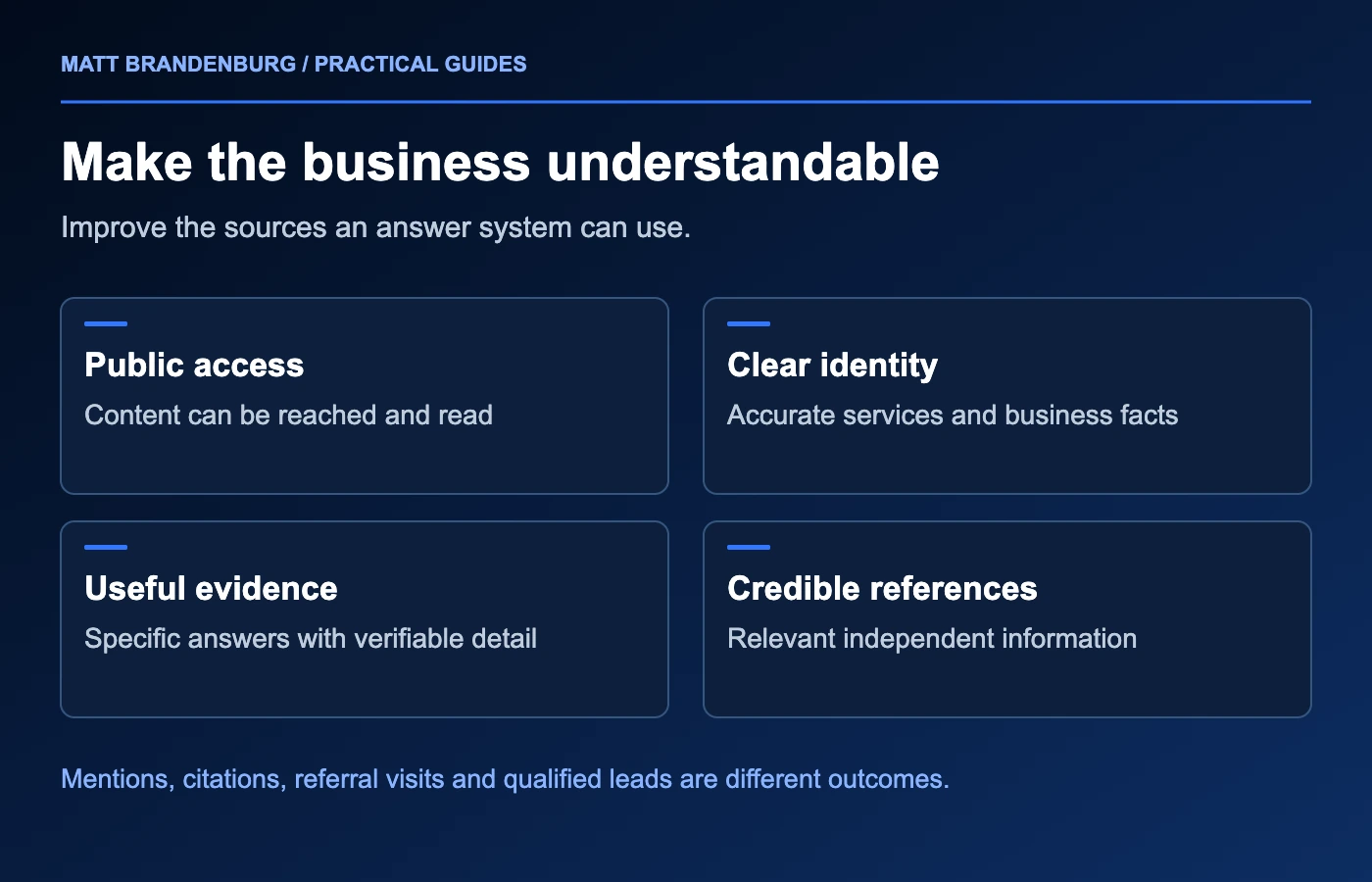
Decide which customer question matters
Start with questions a potential customer would ask before choosing a provider. A request for nearby emergency help is different from a comparison of suppliers or an explanation of a technical specification.
Choose a small set that represents real buying situations. For a fictional equipment supplier, that might include choosing between equipment types, checking installation requirements and comparing maintenance support. Include the customer’s relevant constraints, such as location, application or purchase stage. Do not add the business name to every prompt: that tests recognition when prompted, not whether the business is discovered independently.
For each question, identify the page a person should reach. If no page gives a useful answer, that is a concrete content gap. If several pages give conflicting answers, resolve the conflict before producing more material.
Check access before rewriting content
OpenAI documents different controls for search and model training. OAI-SearchBot is used for ChatGPT search discovery; GPTBot is associated with content that may be used for training. Allowing one does not require allowing the other. OpenAI’s crawler documentation also recommends allowing requests from its published search-crawler IP ranges.
Ask the person responsible for the website to check three things:
- The intended public pages are available without signing in.
- The crawler rules permit the intended search access.
- The hosting, firewall and bot-protection layers are not rejecting legitimate crawler requests.
A page opening successfully in your browser answers only the first question. It does not prove the crawler received the same response. Where available, review server, CDN or firewall logs for requests identifying as OAI-SearchBot and check whether they received a successful response. Compare the source IPs with OpenAI's published ranges, because user-agent strings can be spoofed. Make narrow exceptions rather than weakening security rules broadly.
Also inspect the page itself. The important explanation should be visible text, not information available only after an unusual interaction. Broken links, contradictory canonicals and stale service pages deserve attention as part of the wider search strategy.
Access makes discovery possible. It is not a promise that a particular answer will cite the page.
Make business facts easy to verify
Imagine a buyer trying to establish whether your organization can help. They should not have to reconcile three different service descriptions or guess which locations are real.
Review the homepage, service pages, About page and contact details together. Check the business name, people, services, operating geography and contact methods. Where relevant, compare those facts with legitimate external profiles and industry listings.
Be precise about experience. Describe who performs the work and what they actually know. If a certification, partnership or result is mentioned, provide enough context to verify it. Remove expired credentials and unsupported superlatives instead of creating additional versions of them.
This is also a useful customer-experience exercise. A clearer site helps a person evaluate the business even when they arrive through a channel that has nothing to do with AI.
Publish an answer someone could use
A broad service page explains the offer. A useful supporting article answers a narrower decision. Both need evidence, but they have different jobs.
Consider a page answering whether a particular material fits an industrial application. A generic introduction gives the reader little to evaluate. A stronger page explains relevant operating conditions, comparison criteria, exceptions and what information is needed before recommending an option. A qualified reviewer should check technical limits.
Use the following worksheet to decide what belongs on a page:
| Reader’s question | Useful material | Evidence to attach |
|---|---|---|
| Is this suitable for my situation? | Application and limitation table | Verified specifications or expert review |
| How do these options differ? | Comparison using consistent criteria | Dated product or service information |
| What happens during the work? | Clear process and responsibilities | Real workflow, photographs or sample deliverable |
| What should I prepare? | Practical checklist | Requirements confirmed by the delivery team |
| Why should I trust this claim? | A specific, bounded explanation | Source, methodology or a real example used with the customer's permission |
Do not invent a case study to fill an evidence column. A clearly labeled demonstration can teach a method without pretending it happened to a customer. Original illustrations and worksheets are useful when they make the answer easier to apply.
Review third-party descriptions without chasing every mention
Look at the sources that genuinely matter to customers: professional associations, relevant directories, supplier relationships, publications and review platforms. Correct material factual errors through the normal process for each source.
Prioritize relevance over volume. A credible industry profile that accurately describes a capability can be more useful to a buyer than dozens of unrelated listings. That is a practical reason to improve these sources; it is not a claim that any particular mention guarantees an AI citation.
When researching an answer, inspect the cited pages directly. Check whether they actually support the statements attributed to them. A source appearing beside an answer does not remove the need to verify what the answer says.
Keep a dated visibility scorecard
Each outcome can happen without the next one: a business can be mentioned without being cited, or cited without receiving a visit. Use a repeatable sample rather than a single celebratory screenshot. Record the exact question, date, product or mode, whether search was used, whether the session was signed in or personalized, relevant location context and the source URLs shown. Keep branded questions separate from non-branded ones.
| Observation | What it tells you | What it does not establish |
|---|---|---|
| Business mentioned | The name appeared in that answer | Reliable appearance for all users |
| Website cited | A page was linked as a source | A visit or endorsement |
| Referral visit recorded | A measurable visit reached the site | Every AI-influenced visit |
| Inquiry received | Someone completed a contact action | Qualification or a sale |
| Qualified opportunity recorded | The inquiry met the business criteria | That one answer caused the entire sale |
Repeat the same core questions after meaningful site changes, and keep the previous observations. To connect these observations with leads and revenue reporting, use the marketing measurement framework. If wording, location or product mode changes, note that difference. A sample can identify patterns and errors; it cannot represent every answer a system might generate. Record how referral visits are identified, such as recorded referrers or tagged links; those methods do not capture every visit influenced by an answer.
Choose the next action from the evidence
A missing citation may lead to an access check, a clearer source page or a review of unsupported claims. A cited page that gets visits but no inquiries may need a more useful next step. An inaccurate description may point to conflicting public information.
These are different problems from automating internal work. The guide to AI search visibility and marketing systems explains that distinction.
If you want help choosing the first improvement, start a conversation and bring the customer questions and service pages that matter most. I can help set up a repeatable baseline and identify which work the evidence supports.